
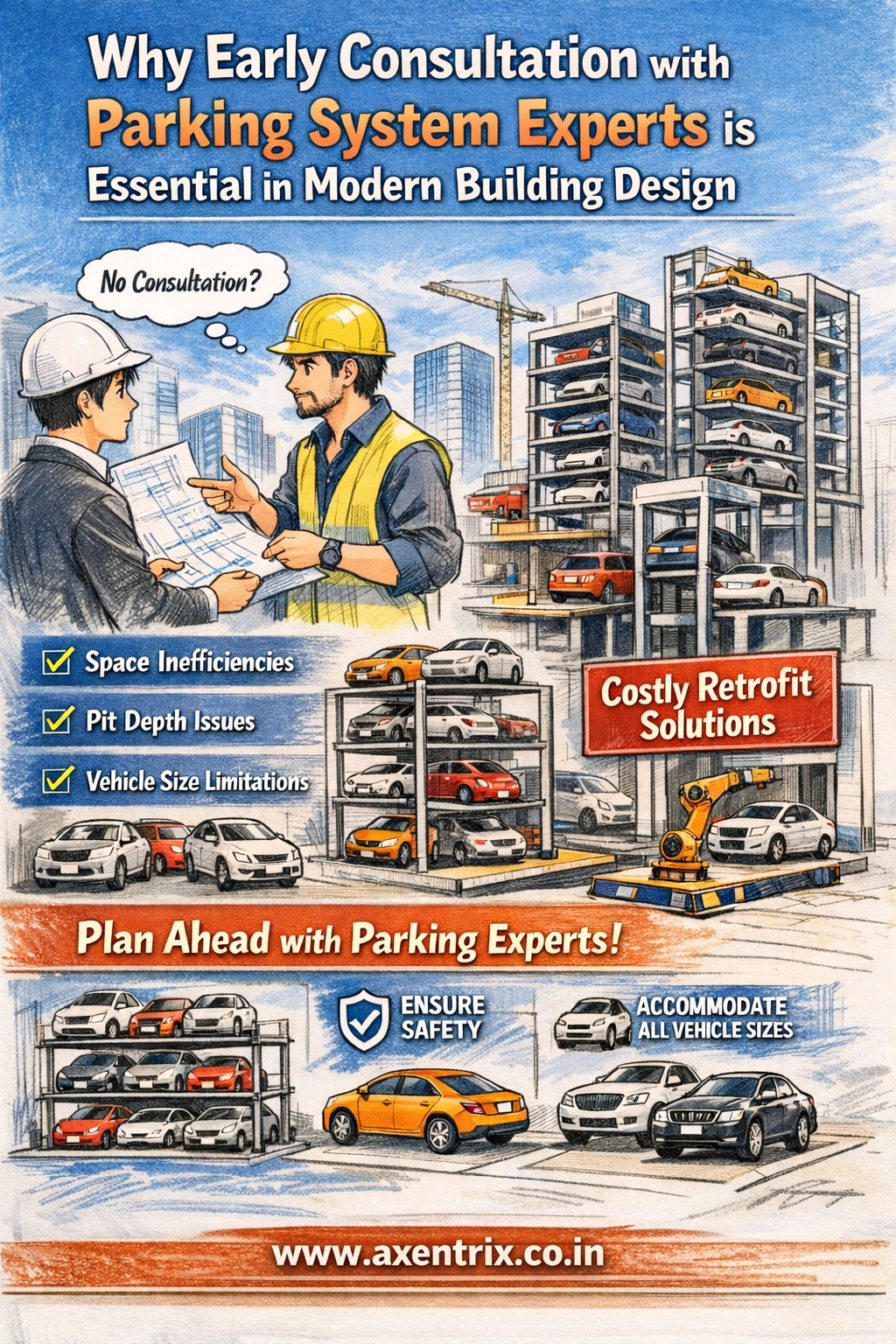
In the rush to design stunning malls, residential towers, or commercial spaces, one crucial element often gets sidelined: parking. More specifically, the complexities of automated parking systems, such as stackers, puzzle systems, towers, and robotic solutions, are sometimes treated as an afterthought.
The result is often costly retrofits, structural compromises, and parking layouts that never reach their potential. At Axentrix, we have seen this pattern repeat itself across projects in Mumbai, Pune, Bangalore, and other Indian cities. This article explains why involving a parking system consultant from day one is one of the most valuable decisions a developer or architect can make.
The Cost of Late-Stage Parking Planning
When architects finalize parking layouts without consulting a parking systems specialist, a common set of problems emerges: space inefficiencies, incorrect turning radius calculations, pit depth misalignments, and designs that cannot accommodate modern vehicle sizes such as SUVs and MPVs. These issues, once embedded in structural drawings, are extremely expensive to fix.
In the worst cases, an automated parking system that could have neatly fit 80 cars in a basement is reduced to 50 to 55 cars with custom structural workarounds, eating directly into the developer's ROI and the building's competitive positioning.
The Pit Depth Problem
One of the most common and costly mistakes involves pit depth. Puzzle parking systems and certain stack systems require precise pit dimensions, typically 1.5 to 2.5 meters deep depending on the car platform design. If the structural engineer finalizes slab and footing depths without accounting for these requirements, the options become either expensive structural changes or a downgraded parking system that accommodates fewer vehicles.
Turning Radius and Approach Zones
Another critical area is the entry/exit approach. Automated systems have specific car entry dimensions including width, length, and turning radius constraints. A driveway designed for a conventional parking layout may be completely unsuitable for a puzzle or tower system. Discovering this post-construction means either demolishing part of the approach or accepting a compromised system entry that damages vehicles.
What Early Consultation Actually Looks Like
At Axentrix, early-stage consultation for an automated car parking system typically involves a site visit or review of architectural drawings, followed by a preliminary layout showing the best fit parking system, the optimal pit design, approach zones, car count estimates, and structural coordination notes that can be shared directly with your structural engineer and architect.
This consultation is fast, usually completed within 3 to 5 working days, and the cost of not doing it far exceeds any consultation fee. For most projects, we provide this preliminary consultation free of charge as part of our project assessment process.
Which Automated Car Parking System is Right for Your Project?
The answer depends on your site constraints, budget, and required car capacity:
- Stack parking systems: Best for private garages, small commercial plots, 2 to 4 car capacity per bay. Lowest cost and complexity.
- Puzzle parking systems: Best for medium basements with 20 to 80 cars in residential towers and commercial buildings. Requires a pit.
- Tower parking systems: Best for high density urban projects with limited land. 20 to 70 plus cars in a small footprint.
- Robotic parking systems: Best for premium projects requiring maximum density and no human entry into the parking structure.
Plan Your Parking the Right Way From Day One
Talk to our parking system engineers before you finalize your structural drawings. We help you maximize car capacity, avoid costly structural revisions, and select the right automated system for your site and budget.
Get Free Parking Consultation